

A garden office can give you a quiet, practical place to work from home without giving up a bedroom, dining table or corner of the living room. For many Sussex homeowners, it can be a smart way to create a dedicated workspace while keeping work separate from family life.
A good garden office is not just a shed with a desk in it. It needs to be comfortable, well-built, properly positioned and designed around how you actually work. That might mean space for video calls, built-in storage, heating, insulation, natural light, reliable power, good internet and enough separation from the house to help you focus.
At FraserWood Construction Ltd, we build bespoke garden rooms across Sussex for work, rest and play. If you are thinking about creating a garden office, here are practical ideas to help you plan the space properly.
Start with how you work
Before choosing the size, layout or finish of a garden office, start with one simple question:
What does your working day actually look like?
A garden office for quiet laptop work will need a different layout from a studio used for design, music, therapy, fitness coaching or client meetings. The best design depends on the way the space will be used.
Think about:
- how many people will use the office;
- whether you need one desk or two;
- how often you take video calls;
- whether clients or visitors will use the space;
- how much storage you need;
- whether you use large screens, printers or specialist equipment;
- whether you need space for creative work, samples or tools;
- whether the office should double as a guest space, hobby room or quiet retreat.
The clearer the brief, the better the result.
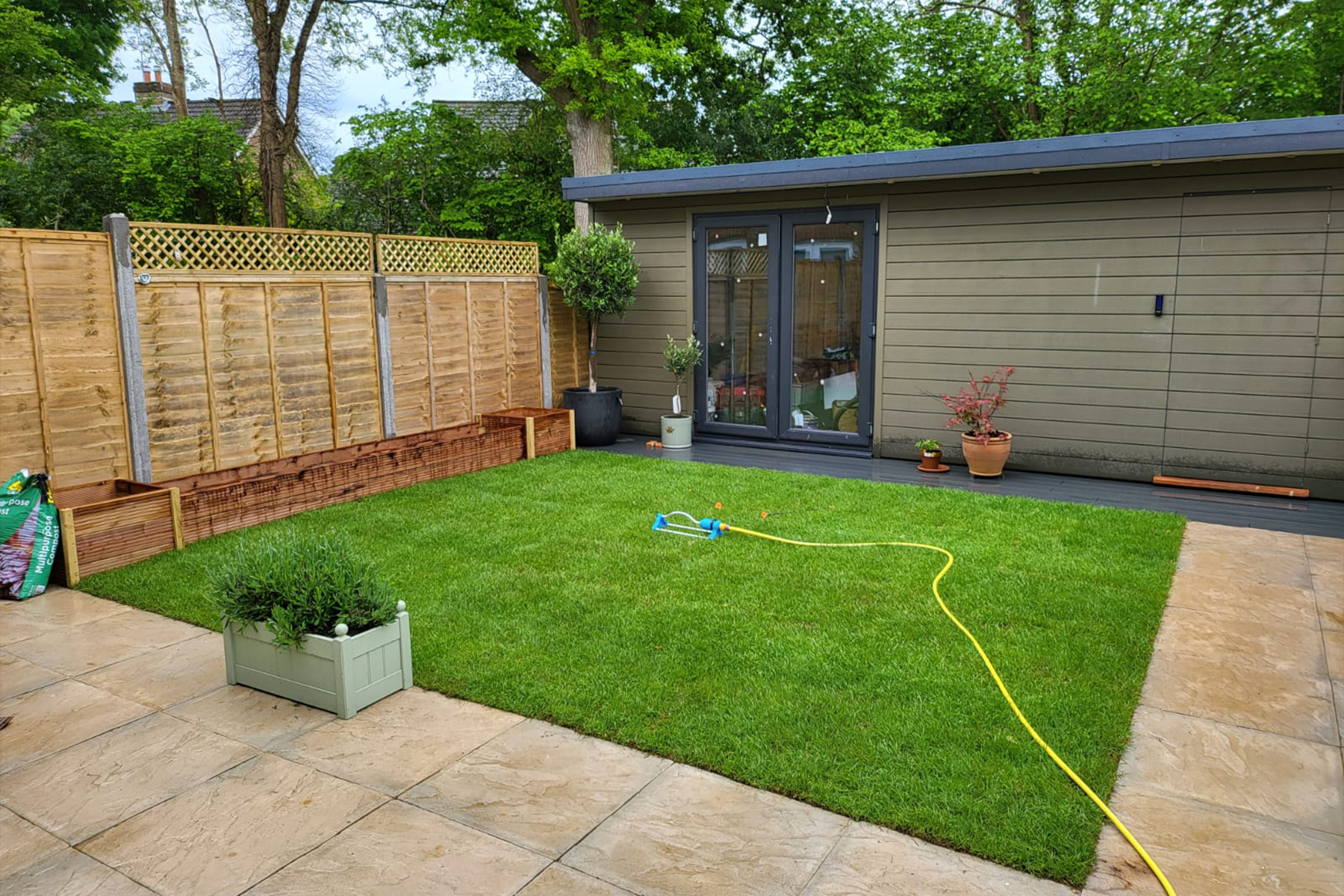
Idea 1: A quiet garden office for focused work
The simplest garden office is a calm, quiet workspace for one person.
This is ideal if you need somewhere to take calls, write, plan, manage admin or work on a laptop without household distractions.
Useful features include:
- a built-in desk;
- good task lighting;
- sockets near the desk;
- wall shelving;
- a comfortable chair position;
- space for a second screen;
- acoustic consideration if you take calls;
- blinds or shading to reduce glare;
- simple storage for paperwork and equipment.
The layout should keep the desk away from strong glare where possible. Natural light is helpful, but a screen facing a bright window can make everyday work uncomfortable. A good design balances daylight, privacy and screen visibility.
Idea 2: A video-call friendly garden office
If your working day includes regular video calls, plan the room around what the camera sees and what the microphone hears.
A video-call friendly garden office should consider:
- the background behind your desk;
- natural light on your face rather than behind you;
- reduced echo;
- a door that closes properly;
- heating and ventilation so you are comfortable on longer calls;
- reliable internet;
- enough sockets for screens, chargers, lights and equipment.
A plain wall, shelving, timber feature or fitted storage can create a tidy background. This matters if you regularly speak to clients, colleagues or suppliers on video.
Small details also help. For example, a shelf for a router, a concealed cable route, or built-in storage for work equipment can keep the room looking professional without clutter.
Idea 3: A two-person garden office
If two people work from home, a shared garden office can make sense.
This could be designed with:
- two desks on opposite walls;
- one long shared worktop;
- built-in storage between workstations;
- separate lighting zones;
- enough sockets for both users;
- acoustic separation where possible;
- a small meeting or reading area.
The main issue with a two-person office is not only space. It is how each person works. If one person spends the day on calls and the other needs silence, the design may need to create distance, storage separation or even a part-screened layout.
For some households, a larger multi-use garden room may work better than a compact two-person office.
Idea 4: A garden office and hobby room combined
A garden office does not have to be only for work.
Many homeowners want a space that works during office hours but becomes useful in the evening or at weekends.
A garden office can also work as a:
- reading room;
- craft room;
- music room;
- art studio;
- gaming space;
- garden snug;
- family room;
- yoga or exercise space;
- quiet retreat.
The key is to design the office so work can be packed away neatly. Built-in cupboards, concealed storage and wall shelving can help the room switch from “work mode” to “home mode” without feeling cluttered.
This is where bespoke carpentry can make a real difference. Instead of filling the room with separate furniture, the storage can be designed into the structure of the space.
Idea 5: A compact garden office for a small garden
You do not always need a large garden to create a useful office.
A compact garden office can still work well if the design is efficient.
For smaller gardens, consider:
- a single-wall desk;
- sliding or outward-opening doors;
- vertical storage;
- narrow shelving;
- built-in cupboards;
- a simple rectangular layout;
- light internal finishes;
- carefully placed windows;
- external cladding that suits the garden.
The aim is to avoid wasting floor space. Freestanding furniture can quickly make a small garden office feel cramped. Built-in storage, a fitted desk and clean wall space can make the room feel much more usable.
Position is also important. In a small garden, the office needs to work with boundaries, neighbours, sunlight, access and the view back to the house.
Idea 6: A garden office with built-in storage
Storage is often overlooked in garden office planning.
A desk and chair may be enough for the first week, but most people eventually need somewhere for:
- files;
- chargers;
- stationery;
- samples;
- printer paper;
- tools;
- equipment;
- coats;
- bags;
- cleaning items;
- Wi-Fi or electrical equipment.
Built-in storage can keep the office tidy and make better use of the room.
Options include:
- cupboards under the desk;
- overhead shelves;
- full-height storage on one wall;
- hidden cable zones;
- printer cupboards;
- open display shelving;
- bench seating with storage underneath.
This is especially useful if the office is also a garden room, studio or family space.
Idea 7: A year-round garden office
If you want to work from the garden office throughout the year, comfort matters.
A year-round garden office needs more thought than a summer-only garden building. It should be designed around warmth, weather protection and everyday use.
Important points include:
- insulation;
- heating;
- ventilation;
- suitable doors and windows;
- weather-resistant external finishes;
- a proper base;
- damp prevention;
- lighting for darker months;
- safe electrical installation;
- internet connection.
Without proper planning, a garden office can be too cold in winter, too hot in summer, or uncomfortable during long working days.
The aim is to make the room feel like a proper workspace, not an occasional outbuilding.
Idea 8: A garden office that matches your home
A garden office should suit the garden and the property.
That does not always mean copying the house exactly. Sometimes a clean modern garden office works well beside an older home. In other cases, traditional timber cladding or a more natural finish may be better.
Design choices include:
- timber cladding;
- painted exterior finishes;
- dark or natural tones;
- matching doors and windows;
- roof style;
- trim details;
- decking or steps;
- paths and access;
- surrounding planting.
A well-designed garden office should feel intentional. It should sit comfortably in the garden rather than look like an afterthought.
FraserWood’s wider construction and carpentry experience is useful here because garden offices often involve more than simply putting up a structure. The details around timber, base, access, weathering and finish affect how the building looks and performs.
Where should a garden office go?
The position of a garden office affects how well it works.
Before choosing the location, think about:
- sunlight during the day;
- glare on screens;
- privacy from neighbours;
- distance from the house;
- access in bad weather;
- garden layout;
- boundary position;
- trees and roots;
- drainage;
- electrical routes;
- Wi-Fi signal.
A garden office placed at the far end of the garden can create good separation from the house. That can help with focus. But it may also need better lighting, a clear path and careful planning for power and internet.
A garden office closer to the house may be easier to access, but it may not create the same feeling of separation.
There is no single correct position. The right answer depends on the garden, the property and how the office will be used.
Do garden offices need planning permission?
Many garden offices may fall under permitted development rules, but only if they meet the relevant limits and conditions. Planning Portal guidance says outbuildings can be permitted development, but the rules are subject to limits on things such as position, height, boundaries, overall garden coverage and whether the property is in a restricted area.
A garden office may need extra care if:
- it is close to a boundary;
- it is tall;
- it is forward of the main house;
- the property is listed;
- the property is in a conservation area or other designated land;
- it would cover too much of the garden;
- it includes a veranda, balcony or raised platform;
- it is intended as separate living accommodation.
Planning rules can depend on the property, location and intended use. If there is any doubt, it is best to check with the local planning authority before work begins. Planning Portal specifically advises contacting the local planning authority if you are unsure whether a planned building counts as an outbuilding or whether planning permission is required.
Do garden offices need building regulations approval?
Planning permission and building regulations are separate things.
Planning permission is about whether the building is allowed in planning terms. Building regulations are about whether certain standards apply to the way it is built.
Planning Portal guidance says building regulations will not normally apply to small detached buildings under 15 square metres if they contain no sleeping accommodation. For detached buildings between 15 and 30 square metres, approval will not normally be required if there is no sleeping accommodation and the building is either at least one metre from a boundary or built substantially from non-combustible materials.
A garden office should not be treated as a bedroom or separate living accommodation unless the correct permissions and requirements have been checked.
For most homeowners, the safest approach is simple: explain exactly how you want to use the garden office before the design is finalised.
What is the difference between a garden office and a shed?
A garden office is designed for regular use. A shed is usually designed for storage.
That difference affects the whole build.
A proper garden office may need:
- insulation;
- internal lining;
- electrics;
- lighting;
- heating;
- better doors and windows;
- a stronger base;
- improved weather protection;
- better security;
- a more finished interior.
A shed may be fine for tools and garden equipment. It is usually not comfortable enough for daily work.
That does not mean an existing garden building is useless. In some cases, an older garden building can be repaired or improved. FraserWood has previously brought an old garden room back to life by installing new windows and doors, matching cladding to the existing design, repairing rotten framework and re-levelling the structure.
What should you include in a garden office brief?
A good brief helps the builder understand what you need.
Before asking for a quote, try to think about:
- the main use of the room;
- how many people will use it;
- whether it needs heating;
- whether it needs internet;
- how much storage you need;
- whether you take video calls;
- whether clients will visit;
- whether you need space for equipment;
- whether the room will be used all year;
- whether you want it to match the house or stand apart;
- whether you already have drawings or example images.
Photos of the garden are useful. Rough measurements are useful too. If you already know where you want the office, take photos from the house, from the proposed garden office position and from the boundaries.
The more information you share early, the easier it is to shape a realistic quote.
Garden office ideas by use
- For remote workers – Keep the layout simple, quiet and comfortable. Prioritise a good desk position, natural light, power, internet and storage.
- For business owners – Think about presentation. Video-call background, client access, storage, lighting and a professional finish become more important.
- For creative work – Allow more open space, display shelving, durable surfaces and good natural light. A studio-style garden office may need more flexibility than a standard desk setup.
- For two-person working – Plan the room around two separate work zones. Think carefully about calls, storage and movement around the desks.
- For occasional work – A smaller garden office may be enough if it is only used a few days a week. It could also double as a hobby room or quiet retreat.
- For family use – Choose a flexible layout. Built-in storage can help the room switch between office, homework space, playroom and weekend room.
Why choose a bespoke garden office?
A bespoke garden office is designed around your garden, your work and your home.
That means you can make decisions about:
- size;
- layout;
- door position;
- window position;
- storage;
- cladding;
- internal finish;
- heating;
- lighting;
- desk location;
- privacy;
- future use.
This is especially useful if the garden is awkward, narrow, sloping, overlooked or already landscaped.
A standard garden office may work well in a simple space. A bespoke garden office is better when the building needs to suit the property properly.
FraserWood garden rooms in Sussex
FraserWood Construction Ltd builds bespoke garden rooms across Sussex for work, rest and play. Our garden room page shows examples including Upton Avenue in Portslade, Masses Close in Thakeham, Black Boys Garden Room and 34 WoodPecker Crescent.
A garden office can be a practical way to create more space without changing the layout of the main house. It can give you a separate place to work, meet, think, create or take calls while still being close to home.
If you are planning a garden office in Sussex, we can help you think through the design, use, position, structure and finish.
Frequently asked questions
Can I use a garden room as a home office?
Yes. A garden room can make an excellent home office if it is designed for regular use. You should think about insulation, heating, lighting, power, internet, desk position, storage and comfort throughout the year.
Does a garden office need planning permission?
Many garden offices may fall under permitted development, but this depends on the size, height, position, property type, location and intended use. If there is any doubt, check with the local planning authority before starting work.
Can a garden office be used all year round?
Yes, but it needs to be designed properly. For year-round use, consider insulation, heating, ventilation, suitable doors and windows, a proper base, weather protection and safe electrical installation.
How big should a garden office be?
The right size depends on how it will be used. A small office for laptop work may only need space for a desk, chair and storage. A two-person office, studio or client-facing workspace will need more room.
Can I put a garden office near a boundary?
You may be able to, but boundary position can affect planning and building regulation considerations. Planning Portal guidance includes height limits for outbuildings within two metres of a boundary.
Is a garden office better than using a spare room?
A garden office can be better if you want separation between home and work. It can free up space inside the house and create a quieter, more focused working environment.
What should I send when asking for a garden office quote?
Send photos of the garden, the approximate size you have in mind, how you want to use the room, your preferred position, any access issues and any design ideas you like. If you have drawings or measurements, send those too.
Planning a garden office in Sussex?
FraserWood Construction Ltd designs and builds bespoke garden rooms for work, rest and play across Sussex. Whether you need a quiet office, a creative studio or a flexible garden workspace, we can help you plan a practical, well-built space that suits your home.
Contact us today to discuss your garden office project and request a free, no-obligation quote.